
Generative engine optimization is redefining how information is discovered, processed, and delivered in the digital ecosystem.
For decades, search engines operated under the “Blue Links” model, where users typed queries and scanned multiple results to find answers. Today, AI-powered search systems are moving toward an “AI Answer” era, where responses are synthesized, summarized, and presented conversationally rather than as a list of links. This transition marks a fundamental shift from retrieval-based search to generation-based intelligence.
Unlike traditional SEO, which prioritizes rankings, backlinks, and keyword density, this new approach focuses on clarity, authority, and structured knowledge that AI systems can interpret and cite. As this transformation accelerates, many businesses are working with trusted SEO agencies and digital intelligence firms to adapt their strategies, ensuring their content remains visible, credible, and influential in AI-driven search environments.
What Is Generative Engine Optimization (GEO)?
Generative search optimization operates within a rapidly evolving ecosystem of AI-powered search and reasoning tools, including Google Gemini, OpenAI’s SearchGPT, Perplexity, Bing Copilot, and other large language model-driven retrieval systems.
These platforms do not simply retrieve links; they analyze, summarize, and generate responses based on a combination of pre-trained knowledge and real-time web data. In this environment, visibility depends less on ranking algorithms and more on whether AI systems consider a source trustworthy, relevant, and well-structured enough to reference.
A key distinction in this ecosystem is the difference between Generative Retrieval and Index Retrieval. Traditional search engines rely on index retrieval, where web pages are ranked based on signals like keywords, backlinks, and technical optimization. AI-driven systems, however, use generative retrieval, which involves selecting, interpreting, and synthesizing information before producing an answer.
Instead of merely pointing users to sources, AI models evaluate multiple references, assess credibility, and construct responses in natural language. This means that brands and publishers must optimize not just for discoverability, but for inclusion in AI-generated knowledge responses.
In this framework, content is no longer judged solely by its ranking potential, but by how effectively it can be understood, extracted, and cited by AI models. Clear structure, factual density, semantic clarity, and authoritative positioning become more critical than traditional SEO tactics alone.
Related Article: AI in SEO: Using These Technologies to Optimize Search Rankings
Why Is GEO Important?
One of the most significant reasons this new form of AI optimization matters is the steady decline of organic click-through rates. The rise of zero-click searches, where users find answers directly within search interfaces without visiting websites, has already reduced traffic for many publishers. With generative AI search, this trend is expected to accelerate, as users increasingly rely on AI-generated responses rather than clicking multiple links. If brands do not adapt, they risk losing visibility even if they rank well in conventional search results.
User behavior is also shifting toward conversational queries. Instead of typing short, keyword-based searches like “best CRM software,” users now ask complex questions such as, “What is the best CRM software for a mid-sized e-commerce business that integrates with Shopify?” AI systems are designed to handle these nuanced queries, making structured, context-rich content more valuable than isolated keyword targeting.
There is also a growing business risk associated with being excluded from an AI system’s training data or live-context window. If a brand’s content is outdated, poorly structured, or lacks credibility, AI models may overlook it in favor of more authoritative sources. This could result in reduced visibility, weaker brand presence, and lost opportunities in AI-driven discovery environments.
Generative Engine Optimization Strategies
This section explores the conceptual approach to making content more AI-friendly. Instead of focusing solely on rankings, the goal is to ensure that information is accurate, structured, and easy for AI systems to interpret, extract, and cite. Each strategy below represents a core pillar of effective AI-first content optimization.
1. Optimizing for Citations and Footnotes
AI models prioritize sources that they can confidently cite, as this helps reduce hallucinations and improve response reliability. To align with this, content creators must structure their writing in a way that makes factual statements easy to extract. This means avoiding vague language, unverified claims, or overly promotional phrasing. Instead, content should present clear, fact-dense sentences that AI systems can recognize as reliable reference points.
Well-organized articles, clear headings, and precise data points increase the likelihood that an AI system will reference a particular source. Websites that consistently publish high-quality, well-researched information build a stronger reputation within AI-driven search ecosystems, improving their chances of being included in generated responses.
2. Enhancing Content Depth (E-E-A-T 2.0)
Traditional SEO emphasized Expertise, Experience, Authoritativeness, and Trustworthiness, but AI-driven optimization requires a deeper focus on genuine experience and originality. Instead of generic blog posts, brands should incorporate real-world case studies, personal insights, proprietary research, and unique perspectives that are not easily replicated.
AI models value content that provides distinctive knowledge rather than recycled information. By including real examples, industry insights, and measurable outcomes, businesses can strengthen their credibility and differentiate themselves in an increasingly competitive digital landscape.

3. Data Density and “Quote-ability”
Generative systems favor concise, fact-rich content that can be easily summarized. This has led to the importance of “knowledge nuggets,” which are short, precise, and highly informative statements that AI models can lift into their answers. Rather than burying key insights in long, complex paragraphs, content should highlight them through bullet points, bolded phrases, or clearly defined takeaways.
Effective data density does not mean cramming information into every sentence. Instead, it means structuring content so that the most important facts stand out. Tables, lists, and clearly formatted sections improve readability for both humans and AI systems, increasing the likelihood that the content will be referenced in summaries.
4. Sentiment and Reputation Management
AI models do not just analyze factual content; they also interpret public sentiment from reviews, forums, and social media discussions. This makes online reputation management a critical aspect of modern AI-first optimization.
Brands must actively monitor their digital presence, respond to customer feedback, and address misinformation. A consistently positive and credible reputation increases trust signals that AI systems may consider when evaluating sources.
5. Natural Language and Conversational Alignment
The shift toward conversational search requires content that mirrors how people actually speak. Instead of optimizing for rigid keyword phrases, brands must anticipate how users phrase their questions in real life. This includes addressing “how,” “why,” and “what” queries in a natural, structured way.
Writing in a clear, conversational tone while maintaining professionalism makes content more accessible to AI systems and users alike. When content aligns closely with real user intent, it is more likely to be retrieved and synthesized into AI-generated answers.

6. The “Source Diversity” Strategy
Visibility in generative search is no longer confined to a single website. AI systems draw from a wide range of sources, including podcasts, videos, academic papers, industry reports, and online discussions. As a result, appearing across multiple platforms strengthens a brand’s perceived authority.
Being featured in reputable publications, participating in expert interviews, and contributing to niche communities all increase the likelihood that an AI system will encounter and reference a brand’s insights. This multi-channel presence becomes as important as traditional on-site optimization.
7. Visual and Multi-Modal Optimization
Modern AI systems are increasingly capable of interpreting images, charts, and visual data. To optimize for these models, visual content must be clear, structured, and well-labeled. Charts should include descriptive titles, properly labeled axes, and meaningful annotations that explain the data.
When visuals are designed with both human and machine interpretation in mind, they become more likely to be referenced in AI-generated responses that incorporate visual reasoning. This expands the scope of optimization beyond text alone.
How Do You Perform Generative Engine Optimization?
This section provides a practical, step-by-step approach to implementing AI-first content strategies. It focuses on actionable tactics that help brands improve their visibility in generative search environments.
1. Conduct a “Brand Hallucination” Audit
Before you can improve, you must know where you stand. Use “system prompts” in various LLMs (e.g., “Who are the top experts in [Your Industry]?”) to see if your brand is mentioned. If the AI gets your facts wrong or ignores you entirely, you’ve identified a “hallucination” or a visibility gap that needs to be addressed through better data sourcing.
2. Implementing Advanced Schema and Structured Data
Schema markup is the “translator” between your website and the AI. While traditional SEO uses schema for snippets, GEO uses JSON-LD to define the relationships between your products, authors, and data points. By providing a clear “knowledge graph” of your site, you make it significantly easier for the AI to extract and verify your information.
3. Creating Proprietary “Information Gaps”
The best way to get cited by an AI is to provide information that it can’t find anywhere else. Conduct original surveys, publish the results of technical experiments, or release white papers based on internal data. When you fill an “information gap,” generative engines will flock to your site as the sole source of that specific data.
4. Entity-Based Content Mapping
Stop thinking in terms of keyword lists and start thinking in “Entity Lists.” Identify the core concepts (entities) your brand should be an authority on. Build a web of interconnected content that covers every facet of that entity. This tells the AI that you are not just a page about a topic, but a comprehensive topical authority.
5. Optimizing for “Contextual Backlinking”
In the world of GEO, the quality of the text surrounding a link is often more important than the link itself. An AI analyzes the “context” of a backlink to understand why your site is being referenced. Aim for links within high-quality, relevant articles where the surrounding sentences explicitly praise your expertise or cite your data.
6. Utilizing LLM-Friendly Formatting
AIs are trained on structured data. Using Markdown (like this article), bulleted lists, and clearly labeled tables allows the model to “parse” your data faster. The easier your content is for a machine to read, the more likely it is to be selected for a synthesized answer.
7. Periodic Content Refreshing for “Live” Context
With models now accessing the “live” web via search plugins, outdated information is a death sentence for rankings. Regularly update your key statistics, price points, and “how-to” guides. Ensuring your data is current prevents the AI from serving “stale” information and losing trust in your site as a reliable source.
GEO vs. SEO
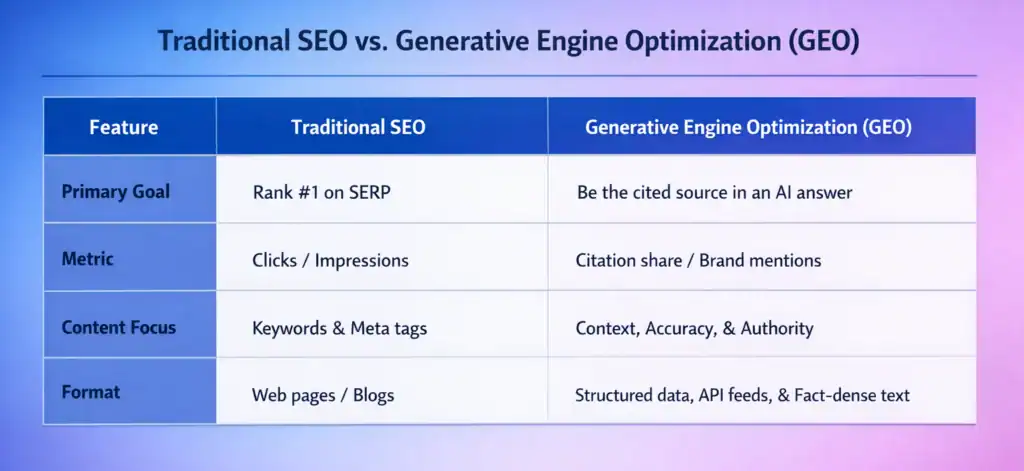
Traditional SEO focuses on ranking in search results, while AI-first optimization prioritizes being cited as a trusted source in AI-generated answers. Instead of measuring success through clicks and impressions, businesses must track citation share, brand mentions, and inclusion in AI summaries. Content strategy shifts from keyword targeting to structured, fact-based knowledge representation.
The Challenges and Ethics of GEO
One of the biggest challenges of GEO is the “Black Box” problem, where brands cannot clearly track rankings or visibility in AI-generated responses the way they could in traditional search. There is no standard dashboard for citation share, making performance measurement uncertain and highly experimental.
Another major risk is AI hallucinations, where models confidently present incorrect information about a brand, product, or topic. This can mislead users and damage credibility if left uncorrected. Finally, there is an ethical tension between optimizing content for AI systems and ensuring it remains genuinely valuable, readable, and meaningful for human audiences rather than purely machine-friendly.
The Future of Search Rankings
Search is moving toward personal AI agents that proactively retrieve, filter, and synthesize information based on individual preferences and behavior. This means rankings will become more personalized rather than universal, making visibility dependent on trust and relevance rather than position on a results page.
SEO is unlikely to disappear entirely, as AI systems will still rely on structured, high-quality web content. However, traditional SEO will evolve into a broader discipline where authority, clarity, and citation-worthiness matter more than keywords and backlinks alone.
Closing Thoughts on GEO
GEO represents a fundamental shift in how digital visibility is earned, moving the focus from surface-level optimization to deeper knowledge credibility. Search is increasingly becoming a reasoning layer rather than a retrieval tool, where intelligent systems interpret information instead of simply ranking it.
In this environment, organizations must think beyond keywords and instead prioritize accuracy, structure, and consistency across their entire digital footprint. The most effective approach is to treat content as a long-term knowledge asset rather than a short-term traffic driver. As AI continues to reshape discovery, lasting success will depend on how well brands communicate, validate, and sustain their expertise in a rapidly evolving information ecosystem.