B2B marketing strategies have evolved far beyond brochures, trade shows, and cold outreach. Modern B2B growth is powered by data, technology, and deeply personalized engagement that aligns marketing with real business outcomes such as pipeline creation, revenue acceleration, and customer retention.
Buyers today conduct most of their research independently, interact with multiple digital touchpoints, and expect relevance at every stage of their journey. As a result, successful organizations blend strategic planning, content excellence, and performance analytics with the expertise of reliable digital marketing agencies to build scalable, measurable systems. Rather than focusing on vanity metrics, leading companies now prioritize quality leads, shorter sales cycles, and stronger customer relationships, making structured and results-driven approaches essential for sustainable growth.
What is B2B Marketing?
Business-to-business (B2B) marketing refers to the strategies, tactics, and processes organizations use to promote products or services to other businesses rather than individual consumers. Unlike B2C, where emotions and impulse often drive decisions, B2B purchasing is typically complex, high-value, and involves multiple stakeholders, longer buying cycles, and rigorous evaluation.
At its core, business-to-business marketing is about building trust, demonstrating expertise, and solving clearly defined business problems. Decision-makers such as procurement managers, department heads, and C-suite executives look for evidence of value, credibility, and long-term partnership potential before committing to a purchase.
Modern B2B marketing combines traditional approaches such as account outreach and industry events with digital-first methods including content marketing, search optimization, social selling, marketing automation, and data-driven analytics. The goal is not just to generate leads but to influence the entire buyer journey from awareness to advocacy.
A successful business to business marketing approach aligns marketing, sales, and customer success teams around shared goals. This ensures that prospects receive consistent messaging, personalized engagement, and a seamless experience across every interaction, whether through email, webinars, sales calls, or digital platforms.
Top B2B Marketing Strategies
To stay competitive in today’s business environment, organizations must move beyond generic marketing approaches that reach everyone but connect with few. Effective B2B marketing strategies focus on targeting the right decision-makers with relevant messaging, using data and insights to drive meaningful engagement. Here is a list of 12 proven approaches that can help businesses generate quality leads, build stronger relationships, and achieve measurable growth:
1. Account-Based Marketing (ABM)
Account-Based Marketing represents a fundamental shift in how organizations perceive their total addressable market. Instead of casting a wide net and hoping to catch a few relevant leads, ABM treats individual high-value accounts as markets of one. This precision-based approach ensures that marketing resources are not wasted on companies that lack the budget or the need for your solution.
Marketing and sales align to create bespoke campaigns—such as personalized landing pages and custom gift boxes—for specific decision-makers at target companies. For instance, if you are targeting a Fortune 500 tech firm, your ABM strategy might involve creating a dedicated white paper that addresses that specific firm’s recent quarterly earnings report challenges. By showing this level of dedication and personalization, you significantly increase the likelihood of bypassing the “gatekeeper” and reaching the executive level.
2. Video-First Content Strategy
The consumption habits of B2B buyers are shifting toward visual and auditory formats. Video is no longer an “extra”; it is a primary medium. A robust video strategy should focus on two distinct areas:
- Micro-video: Short, 60-second clips that demonstrate a single feature, answer a common question, or explain a quick concept. These are highly shareable and ideal for social platforms where prospects spend time exploring industry insights.
- Personalized Video Messaging: Short, tailored videos sent directly to prospects to explain how your solution addresses their specific challenges. A concise 45-second video is often far more effective than a lengthy email, as it delivers a human touch and captures attention quickly.
By integrating video across the entire funnel, from top-of-funnel awareness to bottom-of-funnel tutorials, you create a more engaging and human experience for the prospect.

3. Content Syndication
Even the best content will fail to drive growth if nobody sees it. Content syndication is the process of hosting your high-value assets—such as white papers, webinars, or research reports—on third-party platforms that your target audience already visits. This allows you to generate leads on a fixed Cost-Per-Lead (CPL) basis while borrowing the authority of established publications.
For example, if you sell cybersecurity software, syndicating an ebook on a major IT trade publication puts your brand in front of a pre-vetted audience of IT directors. This is an excellent way to scale lead generation quickly, as it removes the reliance on your own website’s organic traffic. It also provides valuable backlinks and social proof, further strengthening your brand’s position in the market.
4. Intent-Based Targeting
Modern buyers do about 70% of their research before ever speaking to a sales representative. This “dark funnel” activity can be decoded using intent-based targeting. Use “intent data” to identify prospects who are actively researching your category. By tracking behavioral signals—such as visiting a competitor’s pricing page, searching for specific industry keywords, or reading third-party reviews—you can time your outreach precisely when a buyer is in the “consideration” phase.
This strategy allows your team to be proactive rather than reactive. Instead of waiting for a lead to fill out a form, you can identify accounts that are “surging” in interest for your specific service. When combined with B2B digital marketing strategies, intent data ensures that your paid media spend is directed toward people who are actually in-market, rather than a broad demographic that may have no current intent to buy.
5. Employee Advocacy
In an era of AI-generated content and automated bots, buyers trust people more than logos. Personal brands are becoming more influential than corporate brands. Formalizing an advocacy program—where your subject matter experts share their insights on LinkedIn—humanizes your brand and can increase social engagement by up to 30%.
When a Lead Engineer or a Product Manager shares a post about a technical breakthrough or an industry trend, it carries more weight than a generic corporate update. This doesn’t mean your employees should become “salesy”; rather, they should provide genuine value and thought leadership. This organic reach acts as a powerful supplement to your overall B2B digital marketing efforts, as it builds a layer of authenticity that paid ads simply cannot replicate.
6. Search Engine Optimization (SEO) & Answer Engine Optimization (AEO)
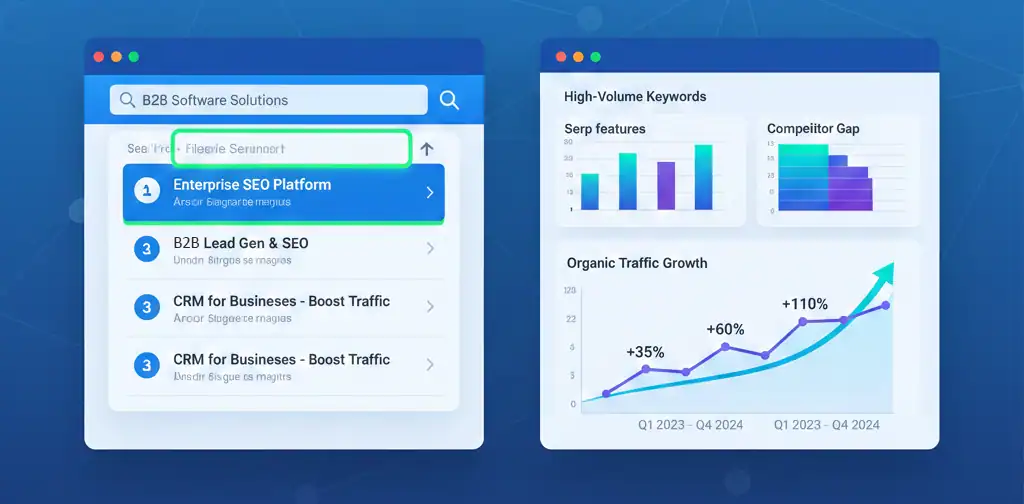
The way people find information is changing. Beyond traditional keywords, you must optimize your content for “zero-click” searches and AI assistants like Perplexity or Gemini. This involves using structured data (Schema) and answering specific, long-tail industry questions in a clear, authoritative format.
B2B SEO is no longer just about ranking #1 for a broad term; it is about becoming the “featured snippet” or the primary source for an AI’s answer. To succeed here, your content must be deeply researched and technically sound. By focusing on AEO, you ensure that when a CTO asks an AI assistant, “What is the most secure way to integrate API ‘X’ with ‘Y’?”, your company’s documentation is the one being cited as the answer.
Many organizations partner with top SEO companies to implement advanced strategies, optimize technical performance, and ensure their content is discoverable across both traditional search engines and AI-driven platforms. Working with experienced SEO specialists can accelerate results and provide measurable improvements in visibility and lead generation.
7. Interactive Tools and Calculators
One of the most effective ways to capture high-quality leads is to provide immediate, tangible value. Provide immediate value with free web-based tools, such as ROI calculators, security graders, or technical assessments. These tools capture lead data effectively because they offer a personalized “result” in exchange for an email address.
A prospect might be hesitant to download a 40-page white paper, but they are often very willing to spend two minutes in an ROI calculator to see how much money your software could save their department. These tools also provide your sales team with incredible data; knowing a prospect’s specific inputs into a calculator allows the salesperson to tailor their pitch to the exact numbers the prospect cares about.
8. Micro-Communities
As the public internet becomes noisier, B2B buyers are retreating into “dark social”—private spaces where they can speak freely with their peers. Build or participate in niche spaces like private Slack channels, Discord servers, or invite-only LinkedIn groups. These smaller “dark social” circles allow for peer-to-peer networking that often influences buying decisions far more than a public ad.
The goal here is not to sell, but to facilitate. By hosting a community for “Heads of Operations in Manufacturing,” you position your brand as a facilitator of industry progress. When a member of that community eventually needs a solution like yours, your brand will be the first one they trust because you have provided a platform for their professional growth.
9. Hyper-Personalized Email Nurturing
The days of the “monthly newsletter” sent to your entire database are over. To drive growth, companies must move away from generic “drip” campaigns. Use AI to trigger emails based on specific actions, such as a lead downloading a specific case study or visiting your “Integrations” page multiple times.
The content should shift dynamically to match the lead’s industry, role, and current pain point. For example, if a lead from the healthcare sector downloads a security white paper, your next three emails should focus on HIPAA compliance and data privacy in healthcare, rather than generic product features. This level of relevance ensures higher open rates and, more importantly, keeps the prospect engaged through a long sales cycle.
10. Experiential & Event Marketing
Digital marketing is essential, but as digital fatigue grows, high-touch physical experiences have made a comeback. Focus on “field marketing” events—small, exclusive VIP dinners or workshops—that prioritize relationship-building over hard-selling.
Inviting ten high-level executives to a private roundtable discussion with a guest speaker often results in more pipeline than a 1,000-person webinar. These intimate settings allow for real conversations and the building of rapport that is difficult to achieve through a screen. In B2B, where trust is the primary currency, the “handshake” still holds immense value.
11. Customer Proof & Advocacy
B2B buyers rely heavily on peer validation. They want to know that someone else with their specific problem has successfully used your solution. Beyond standard case studies, incentivize your best customers to leave reviews on platforms like G2 or Capterra.
User-generated content (UGC) and “video testimonials” are often cited as the most trustworthy assets in the funnel. A raw, unedited video of a customer explaining how your platform saved them ten hours a week is far more convincing than a polished marketing brochure. Make customer success a core part of your marketing engine by systematically collecting and distributing these stories across your social and sales channels.
12. Paid Social Retargeting
The B2B journey is rarely linear. Most B2B buyers won’t convert on the first visit. Use retargeting ads on LinkedIn and Meta to stay top-of-mind. However, the key is to provide value in the retargeting, not just a sales pitch.
Instead of a generic “Book a Demo” ad, serve them a relevant educational resource that helps them solve the specific problem they were just researching on your site. If they looked at your blog post about “Supply Chain Optimization,” your retargeting ad should offer them a “Supply Chain Audit Checklist.” This keeps the relationship helpful and educational, moving them closer to a purchase decision without being intrusive.
Conclusion
Successfully implementing B2B marketing strategies requires a blend of technical precision, creative storytelling, and an unwavering focus on the customer’s needs. By moving away from siloed tactics and adopting a holistic approach—from intent-based targeting to the creation of micro-communities—businesses can build a resilient growth engine. Remember that in the realm of B2B marketing, the goal is to build relationships that withstand market fluctuations and technological shifts. By consistently providing value and leveraging the right data, your organization can achieve not just visibility, but sustainable and measurable business growth.