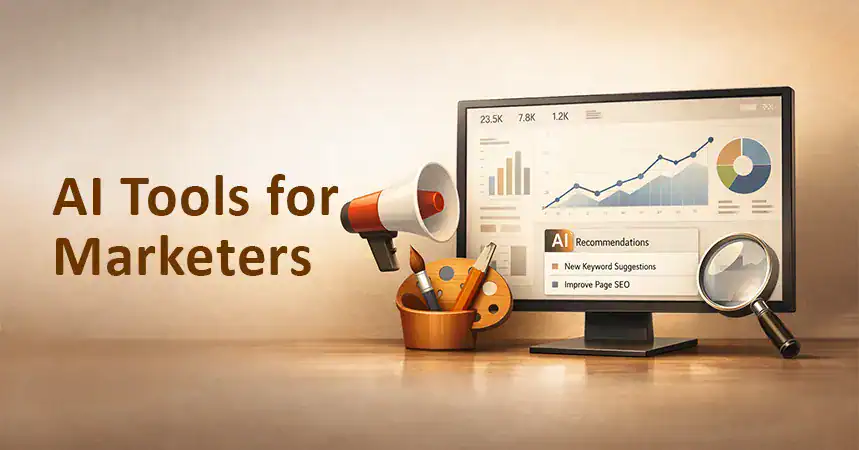
AI tools for marketers have rapidly transformed how modern businesses plan, execute, and optimize their digital marketing efforts. What once required large teams, long timelines, and manual analysis can now be achieved faster and more accurately with the help of artificial intelligence. From automating repetitive tasks to uncovering meaningful insights from data, AI has become a powerful growth driver for marketers at every level.
Marketing teams today operate under constant pressure to move faster, scale efficiently, and deliver measurable results. Campaigns must launch quickly, adjust in real time, and respond to changing customer behavior without losing momentum. AI-powered platforms make this possible by streamlining workflows, improving personalization, and supporting data-driven decision-making. These tools are no longer experimental or optional. They are now essential components of high-performing marketing strategies.
This article is designed for marketing professionals, founders, content creators, and teams working with expert digital marketing agencies who want to understand how AI can help them grow faster and smarter. You will learn why AI tools matter, how they fit into modern marketing workflows, and which platforms are worth exploring to improve productivity, creativity, and performance.
Why AI Tools Matter for Modern Marketing
The transition from manual marketing to AI-driven workflows marks the most significant shift in the industry since the advent of social media. In the past, launching a campaign required weeks of coordination between copywriters, designers, and data analysts. Today, AI tools for marketing have compressed that timeline into hours, if not minutes.
Faster Execution and Scalability
One of the primary benefits of AI is its ability to handle “the heavy lifting.” Automating tasks like keyword research, email segmentation, and ad formatting allows teams to scale their output without a linear increase in headcount. This scalability is crucial for businesses looking to expand into new markets or launch multiple product lines simultaneously.
Data-Driven Targeting and Higher ROI
Modern AI models excel at pattern recognition. By analyzing vast datasets—including browsing behavior, purchase history, and social sentiment—these tools can predict which customers are most likely to convert. This precision reduces wasted ad spend and significantly boosts Return on Investment (ROI). Instead of casting a wide net, marketers can now use “laser-guided” tactics to reach the right audience at the perfect moment.
Staying Competitive in Crowded Markets
As more companies adopt advanced technologies, the “baseline” for marketing quality has risen. Consumers now expect personalized recommendations and instant responses. To stay competitive, marketers must adopt a “human-in-the-loop” approach, where AI handles the data and automation while humans provide the creative spark and ethical oversight.
Top AI Tools for Marketers to Grow Faster
Below is a curated list of widely used and impactful platforms that support different areas of marketing, from SEO and content creation to design, productivity, and analytics.
1. Google Gemini
Google Gemini has evolved into a cornerstone of the modern marketer’s toolkit. In 2026, its multimodal capabilities allow it to process text, images, video, and audio simultaneously. For marketers, this means you can upload a video advertisement and ask Gemini to generate a blog post, social media captions, and a performance analysis based on visual cues. Its deep integration with Google Workspace makes it one of the most versatile AI tools for marketers who need to move from ideation to execution within a single ecosystem. It is particularly effective for cross-channel campaign planning and high-level data synthesis.
2. Semrush Copilot
Semrush Copilot acts as an intelligent SEO strategist, moving beyond simple keyword tracking to provide proactive, personalized recommendations. By analyzing your website’s performance against real-time competitor data, it flags specific technical issues and identifies high-potential content gaps. This tool is designed to cut through the noise of traditional SEO reports, delivering a prioritized checklist of “quick wins” to improve your rankings. For marketers, this means spending less time in spreadsheets and more time executing strategies that drive organic traffic. It essentially bridges the gap between raw data and actionable search engine growth.
3. ChatGPT
ChatGPT remains the most flexible assistant for everyday marketing tasks. Beyond drafting copy, marketers use it to build custom GPTs tailored to specific brand voices, analyze customer feedback transcripts, and even write basic code for tracking pixels. It serves as a 24/7 brainstorming partner that can help structure campaign outlines or refine email sequences. For those seeking free AI tools for marketing, the base version offers incredible utility in speeding up the first-draft process. Its ability to iterate on complex prompts makes it an invaluable asset for creative problem-solving and rapid content generation.
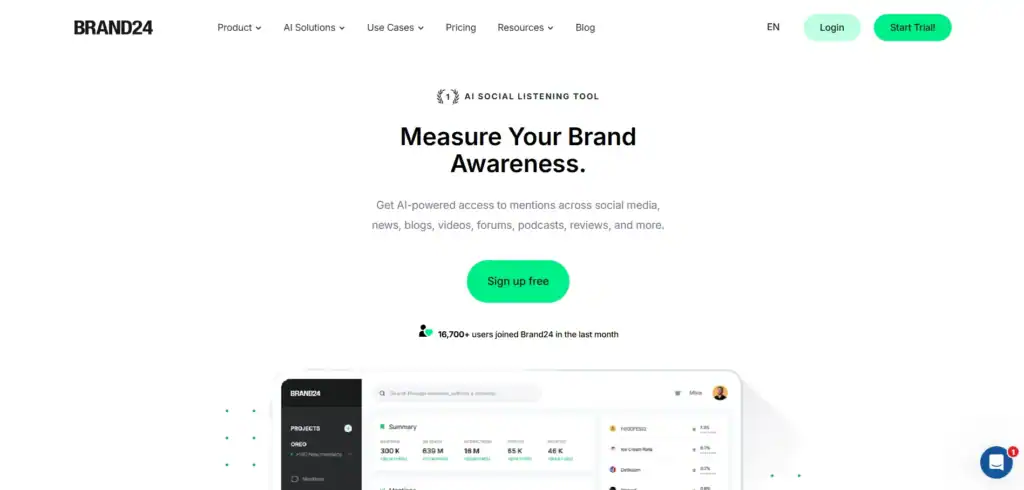
4. Brand24
In the fast-paced world of social media, Brand24 provides vital real-time monitoring of your digital reputation. It uses AI to perform deep sentiment analysis, categorizing brand mentions as positive, negative, or neutral across the web. Its “Anomaly Detector” is particularly useful, alerting marketers to sudden spikes in mentions that could indicate a viral success or a developing PR crisis. By providing a clear “Social Search” score and influencer identification, it helps teams understand who is driving the conversation around their brand. This allows for immediate engagement and more informed community management strategies.
5. Evertune AI
As consumers shift from traditional search engines to AI assistants like Claude or Perplexity, Evertune AI has emerged as a leader in “Generative Engine Optimization” (GEO). This platform tracks how often and in what context your brand is cited by Large Language Models. It provides a unique “AI Brand Index” that quantifies your brand’s authority and visibility within AI-generated responses. By identifying the specific sources and content that influence AI perceptions, Evertune helps marketers optimize their digital footprint to ensure they are recommended to users. It is an essential tool for future-proofing your brand’s discoverability.
6. MarketingBlocks
MarketingBlocks is an all-in-one AI power-house designed to create entire marketing assets from a single prompt. It uses specialized AI agents to generate landing pages, ad banners, promotional videos, and even professional voiceovers in minutes. This tool is a game-changer for small businesses or lean teams that need high-quality creative output without the overhead of multiple specialist hires. By centralizing asset creation, it ensures brand consistency across different media types. It effectively democratizes high-end production, allowing users to build a complete marketing funnel with minimal technical or design expertise.
7. AdCreative.ai
AdCreative.ai focuses specifically on high-converting display ad designs. It uses a vast database of historical ad performance to generate hundreds of creative banners and social media ads tailored to your brand’s logo and color palette. Each design comes with a “conversion score,” predicting its likelihood of success before you commit any ad spend. This data-backed approach reduces the guesswork in A/B testing and significantly speeds up the creative production cycle for platforms like Meta and Google. It is one of the best AI tools for marketing professionals who prioritize performance and ROI in their paid campaigns.
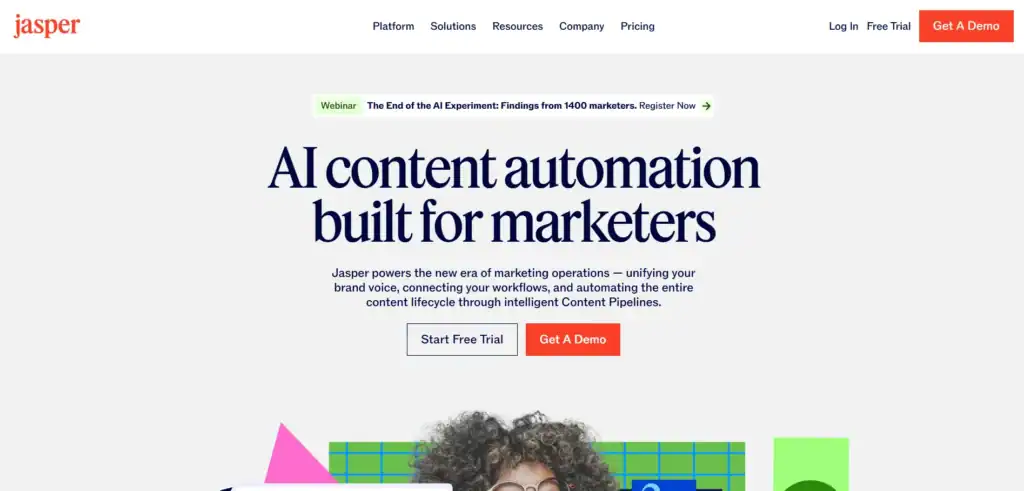
8. Jasper AI
Jasper AI is built for enterprise marketing teams that require a consistent brand voice across large-scale content production. Unlike generic AI, Jasper allows you to upload your style guide and product data to ensure every blog post, case study, and white paper sounds authentic. It features a robust campaign builder that can turn a brief into dozens of coordinated assets simultaneously. Its integration with SEO and grammar tools makes it a professional-grade solution for long-form content. Jasper excels at helping large organizations maintain high standards of quality while significantly increasing their publishing frequency.
9. Copy.ai
Copy.ai has transitioned from a simple copywriting tool into a “Marketing OS” that automates complex workflows. Marketers can build “Workflows” that automatically transform a single input—like a product URL—into a blog post, a series of LinkedIn updates, and a nurture email sequence. This focus on automation makes it ideal for managing repetitive social media tasks and scaling sales outreach. It is highly valued for its user-friendly interface and the ability to connect various marketing tools into a seamless, automated pipeline. It essentially allows marketers to put their content distribution on autopilot.
10. Surfer SEO
Surfer SEO has redefined content optimization by providing a data-driven “recipe” for ranking on page one. It analyzes the top-performing pages for your target keywords and provides real-time feedback on word count, heading density, and NLP term usage as you write. In 2026, it also includes features to track visibility within AI-powered search results, helping you adapt to the “Answer Engine” era. By taking the guesswork out of technical SEO, Surfer ensures that every piece of content you produce is mathematically optimized to compete for the highest possible organic visibility.
11. Superhuman
Superhuman uses AI to turn the marketing inbox from a source of stress into a competitive advantage. It automatically prioritizes your most important messages, summarizes long email threads, and uses AI to draft replies based on your past writing style. For marketing managers dealing with constant vendor inquiries, team updates, and partner outreach, it saves hours of administrative work every week. Its “Get Me Up to Speed” feature provides a quick recap of missed conversations, ensuring you never lose track of a lead or a project update. It is the ultimate tool for high-velocity communication.
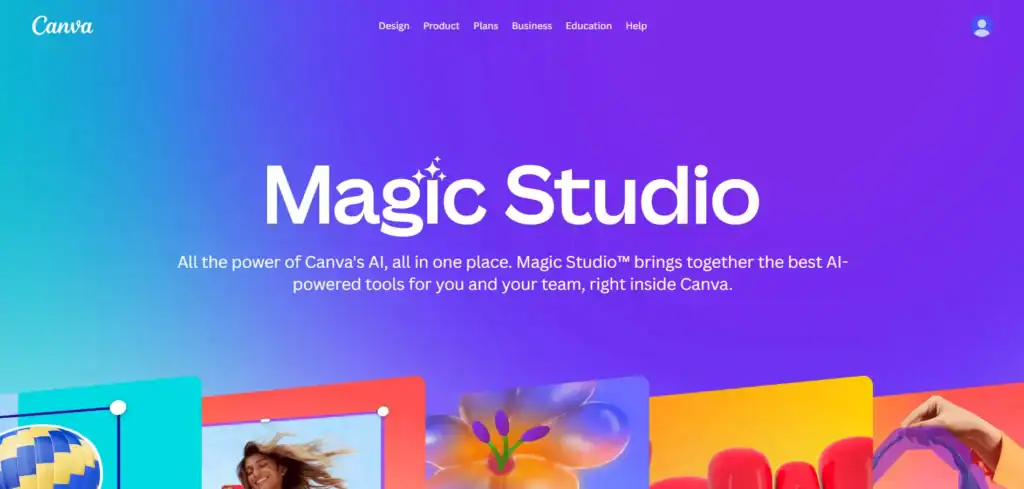
12. Canva (Magic Studio)
Canva’s Magic Studio is among the best AI tools for marketers, helping create professional visuals fast with easy, AI-powered design features. Features like “Magic Media” generate images and videos from text, while “Magic Switch” can instantly transform a presentation into a blog post or an Instagram story. Marketers use its AI-powered background remover and photo expander to polish visual assets in seconds. This level of accessibility means that social media managers and content creators can produce stunning, high-fidelity graphics without needing to master complex software like Photoshop. It is a vital tool for maintaining a modern, visual brand identity at scale.
13. Motion
Motion acts as an AI executive assistant that manages your entire marketing calendar. Instead of a static to-do list, Motion uses a complex algorithm to automatically schedule your tasks around your meetings. If a campaign launch date shifts or an emergency arises, the AI reshuffles your daily plan to ensure high-priority work still gets done. For marketers managing multiple stakeholders, it eliminates the “planning fallacy” and reduces burnout by ensuring a realistic and optimized daily workflow. It ensures that the most impactful strategic work is never sidelined by small, administrative tasks.
14. Otter.ai
Otter.ai transforms marketing meetings into actionable knowledge bases. It joins your virtual calls to provide real-time transcription and, more importantly, an AI-generated summary that highlights key decisions and assigned tasks. Marketers use it to document brainstorming sessions, client interviews, and strategy meetings without the distraction of note-taking. The searchable database of past conversations allows teams to quickly find specific insights or feedback from months prior. It bridges the gap between verbal collaboration and documented execution, making every meeting significantly more productive and accountable for the entire marketing team.
15. Beautiful.ai
Beautiful.ai is an AI presentation tool that ensures your marketing pitches and reports always look professional. As you add content, the slides automatically adjust their layout, alignment, and typography based on design best practices. This “Smart Slide” technology means you never have to spend hours fiddling with text boxes or image placement again. It allows marketers to focus entirely on their narrative and data, confident that the final deck will be visually stunning and on-brand. It is the perfect tool for winning over clients or internal stakeholders with high-impact, beautifully designed visual stories.
Conclusion
AI tools for marketers are no longer just productivity enhancers. They are strategic assets that help teams move faster, make smarter decisions, and scale their impact. From content creation and SEO to design, analytics, and task management, AI-powered platforms support every stage of the marketing funnel.
The key to success is not using every available tool, but choosing the right ones based on clear goals and workflows. Strategic adoption allows marketers to avoid tool overload while maximizing value and efficiency.
As competition intensifies and customer expectations rise, staying relevant requires continuous learning and adaptation. By thoughtfully integrating AI tools for marketing into daily operations, marketers can build resilient strategies, deliver better experiences, and stay competitive in an increasingly AI-driven digital world.