The concept of answer engine optimization is becoming increasingly important as search behavior continues to evolve. Instead of simply browsing through multiple web pages, users now expect direct, accurate answers to their questions within seconds.
Traditional search engines are gradually transforming into answer engines that use artificial intelligence to understand queries and provide summarized responses. AI-driven search experiences are growing across platforms developed by organizations like Google and OpenAI, as well as voice-enabled assistants that respond instantly to spoken questions.
Because of this shift, businesses must focus on optimizing content that delivers clear answers rather than only trying to rank web pages. Companies that invest in reliable SEO services and structured content strategies are better positioned to stay visible in this evolving search landscape.
What Is Answer Engine Optimization (AEO)?
Answer engine optimization refers to the process of structuring and optimizing content so that AI-driven search systems can easily extract and present direct answers to user queries. When people ask a question online, modern search platforms aim to provide the most relevant information immediately, often without requiring users to open multiple websites. AEO focuses on making content clear, organized, and informative so that these systems recognize it as a reliable source.
To understand what AEO is in practice, it helps to look at how search technology works today. Instead of only matching keywords, AI-powered platforms analyze context, user intent, and the relationships between topics. They look for content that directly answers a question, explains a concept clearly, and provides accurate details.

AEO works by aligning your content with how answer engines collect and present information. AI systems scan web pages to identify structured content such as definitions, step-by-step explanations, frequently asked questions, and summarized insights. When content is organized properly, these systems can easily extract useful information and display it as a featured snippet, an AI-generated summary, or a voice response.
For example, when someone searches for a specific question, the search engine may highlight a short paragraph from a website that provides a direct answer. In other cases, AI-driven platforms generate summaries that combine information from multiple trusted sources. Voice assistants also rely on well-structured content to determine which response to read aloud. This is why content clarity, structure, and credibility play a central role in modern search visibility.
Understanding AEO helps businesses adapt to the way users interact with information today. Rather than focusing solely on traditional rankings, organizations must also consider how their content can serve as the primary answer to a question.
Why Is AEO Important?
The following points outline why answer engine optimization strategies are essential for modern brands:
1. Helps You Appear in Zero-Click Searches
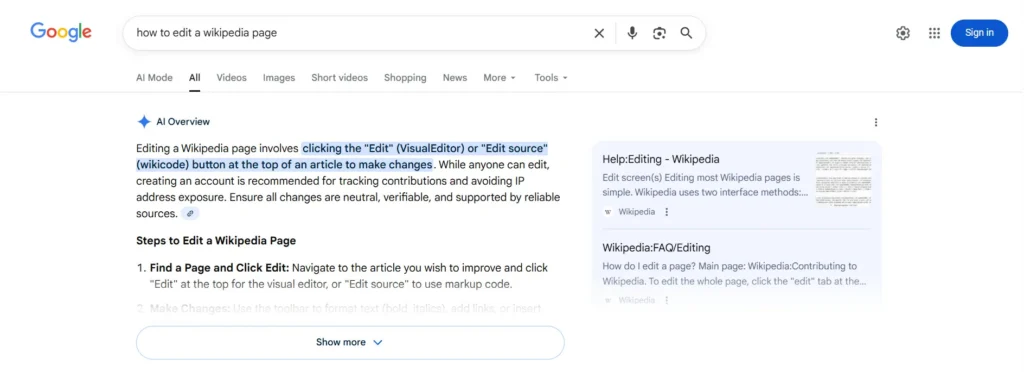
Many searches now end directly on the results page because AI systems provide instant answers. Answer Engine Optimization helps ensure your content becomes the source used in these answers on platforms like Google, keeping your brand visible even when users do not click through. Even without a click, your brand name is associated with the solution, maintaining top-of-mind awareness.
2. Essential for Voice Search Results
Voice assistants typically deliver only one answer. AEO increases the chances of your content being selected as the spoken response in assistants such as Apple Siri, Amazon Alexa, and Google Assistant. In a voice-first world, being the second or third result is essentially the same as being invisible.
3. Supports AI-Generated Search Summaries
Modern search experiences rely on generative AI summaries. Properly structured and clear content makes it easier for AI systems like those developed by OpenAI to interpret, summarize, and cite your information. Google also provides guidance on optimizing websites for generative AI features in Google Search. This ensures your brand is part of the conversational narrative that AI provides.
4. Builds Authority and Trust (E-E-A-T)
When AI engines reference your website as a source, it strengthens your credibility. Being cited as a trusted source improves perceived expertise, authority, and reliability. This creates a virtuous cycle where search engines view you as a leader in your niche.
5. Captures High-Intent Search Moments
Users asking specific questions often have immediate needs or purchase intent. AEO helps your content appear exactly when users are looking for solutions or recommendations. If a user asks, “What is the best way to clean a leather sofa?” and your product is mentioned in the answer, the path to conversion is significantly shortened.
6. Expands Visibility Across Multiple AI Platforms
Optimized content can be used not only in search engines but also in AI tools such as Perplexity AI and AI assistants built by Anthropic, increasing your reach across different platforms. These tools often “browse” the web to find the most up-to-date answers, and AEO ensures you are “findable.”
7. Helps Control Accurate Brand Information
Without optimized content, AI systems may pull information from less reliable sources or user-generated forums. AEO ensures that the most accurate and structured information about your brand is available to answer engines, reducing the risk of misinformation or “hallucinations” about your services.
8. Improves User Experience and Content Readability
AEO encourages structured content with headings, summaries, and concise explanations. This improves readability, engagement, and overall usability for both users and AI systems. What is good for an AI bot is often great for a human reader looking for a quick answer.
9. Reduces Customer Support Effort
Well-optimized FAQs and help content allow AI tools and search systems to answer common questions automatically, which can reduce the need for direct support. If the answer engine provides the solution to a technical setup question, the user doesn’t need to call your help desk.
10. Captures Long-Tail and Conversational Queries
AEO focuses on detailed questions and conversational searches. While each query may have lower volume, these searches often have higher relevance and conversion potential. It targets the “how,” “why,” and “where” of user behavior.
11. Supports Entity-Based Search and Topical Authority
Modern search engines understand topics and relationships between entities rather than just keywords. AEO helps establish your website as a reliable source of information within a specific subject area, marking your brand as an “entity” that the engine can trust.
How Answer Engines Work
The key components that explain how answer engines operate are outlined below.
Natural Language Processing in Search
Natural language processing allows AI systems to understand how people speak and write. Instead of focusing only on individual keywords, these systems analyze the meaning behind a question.
When someone asks a question, the search system interprets context, intent, and relationships between words. This helps determine the type of answer the user expects. For example, a query asking for a definition requires a different response than one asking for a step-by-step guide.
Content written in a clear and conversational style is easier for these systems to interpret. This is why structured explanations and straightforward language improve visibility in answer-based results.
AI Models and Information Retrieval
AI models are designed to analyze large amounts of information and identify reliable sources. They evaluate factors such as accuracy, relevance, and clarity when selecting content for responses.
Information retrieval systems scan indexed web pages to find the most relevant data related to a query. Once the system identifies useful content, it extracts key details that answer the question directly. In some cases, the AI may combine insights from multiple sources to create a summarized response.
For businesses and publishers, this means that high-quality content with clear explanations has a greater chance of being selected by these systems.
The Role of Structured Data
Structured data helps search systems better understand the meaning and context of content. By using schema markup, websites can label important elements such as FAQs, product details, and definitions.
When structured data is implemented correctly, it provides additional signals that help AI engines interpret the information on a page. This increases the likelihood of appearing in enhanced search results or answer-based features.
Structured data also improves how content is categorized and displayed, making it easier for both users and AI systems to access relevant information.
Content Extraction and Summarization
Answer engines rely on extraction techniques to identify the most relevant sections of content. They analyze headings, paragraphs, and lists to determine where direct answers are located.
Once the system identifies the most useful content, it may display it as a snippet, generate a summary, or provide a spoken response through voice assistants. Content that begins with a concise explanation followed by supporting details is particularly effective for this process.
By structuring information in a logical and easy-to-read format, publishers increase the chances that their content will be used as the primary answer.
Answer Engine Optimization Strategies
Effective AEO strategies help websites become reliable sources of answers for modern search systems. The key steps are explained below.
1. Create Question-Based Content
One of the most effective approaches in answer-focused optimization is building content around real user questions. Start by researching the queries people commonly search for in your industry. These questions can come from search suggestions, customer support interactions, online forums, and keyword research tools.
Once you identify these questions, structure your content so that each section addresses a specific query. Use question-style headings that mirror how users naturally search for information. For example, instead of writing a general heading, phrase it in the same way a user might ask a question.
After the heading, provide a direct answer immediately. Then expand the explanation with supporting details, examples, or context. This format helps answer engines quickly identify the relevant portion of your content.
2. Provide Clear and Direct Answers
Answer engines prioritize content that delivers information quickly and accurately. This means the most important information should appear at the beginning of a section rather than being buried deep within the text.
A helpful method is to start with a short, clear response that summarizes the main point. After that, you can expand with additional details, examples, or deeper insights. This layered approach improves readability and allows AI systems to extract the concise answer easily.
Clarity also matters. Avoid overly complex sentences and unnecessary jargon when possible. Write explanations that are easy to understand while still being informative and authoritative.
3. Optimize Content Structure for Answer Extraction
The structure of your content plays a major role in how answer engines interpret it. Organized pages help AI systems scan and identify relevant information more efficiently.
Some structural elements that improve extraction include:
- Clear headings and subheadings that define each topic.
- Short paragraphs that focus on a single idea.
- Lists and numbered steps where appropriate.
- Summary statements that highlight key insights.
These elements help search systems locate answers quickly. At the same time, they make the content more user-friendly.
4. Use Structured Data Markup
Structured data markup allows search engines to better understand the purpose of your content. Implementing schema types such as FAQ schema, article schema, or product schema provides additional context about the information on your page.
For example, FAQ schema can highlight commonly asked questions and their answers. This increases the chances that your content will appear in enhanced search results or AI-generated summaries.
Structured data also improves how information is categorized and indexed, which can strengthen visibility across different answer platforms.
5. Focus on Search Intent and Topic Relevance
Understanding search intent is essential for effective AEO. When users ask a question, they expect specific types of answers. Some queries are informational, while others may be transactional or comparative.
Content should address the real purpose behind the search. This means providing complete explanations rather than just brief mentions of keywords. Cover related subtopics, clarify common misunderstandings, and provide context that helps users fully understand the topic.
When your content aligns with user intent, answer engines are more likely to recognize it as relevant and useful.
6. Build Topical Authority
Topical authority refers to establishing expertise within a specific subject area. Instead of publishing isolated pieces of content, create a network of related articles that explore different aspects of the same topic.
For example, if your focus is digital marketing, you might publish guides, tutorials, case studies, and FAQs related to that field. Internal linking between these pieces helps search engines understand the relationships between them.
Over time, this signals expertise and reliability, increasing the likelihood that answer engines will reference your content as a trusted source.
7. Optimize for Voice and Conversational Search
Many queries submitted to answer engines are conversational. Users often phrase their searches as full questions, especially when using voice assistants.
To optimize for this, write content that reflects natural language patterns. Include phrases that mirror how people speak. For instance, consider how someone might verbally ask a question rather than typing a short keyword phrase.
Content that matches conversational queries has a better chance of being selected as a spoken response by voice-enabled devices.
8. Ensure Fast, Mobile-Friendly Pages
Page performance is an important factor in modern search visibility. Websites that load quickly and function smoothly on mobile devices provide a better experience for users.
Answer engines often prioritize content from sites that are accessible and easy to navigate. Optimizing page speed, reducing unnecessary scripts, and ensuring responsive design can improve both usability and discoverability.
A fast and well-optimized website also increases the chances that users will stay engaged once they access the content.
9. Keep Content Updated and Reliable
Accuracy is a key factor in how answer engines evaluate content. Outdated or incorrect information is less likely to be selected as a reliable answer.
Regularly review your content to ensure it reflects current knowledge, best practices, and verified information. Updating statistics, refining explanations, and improving clarity can strengthen the overall quality of your pages.
Consistent updates signal to search systems that your content remains trustworthy and relevant.
AEO vs. SEO
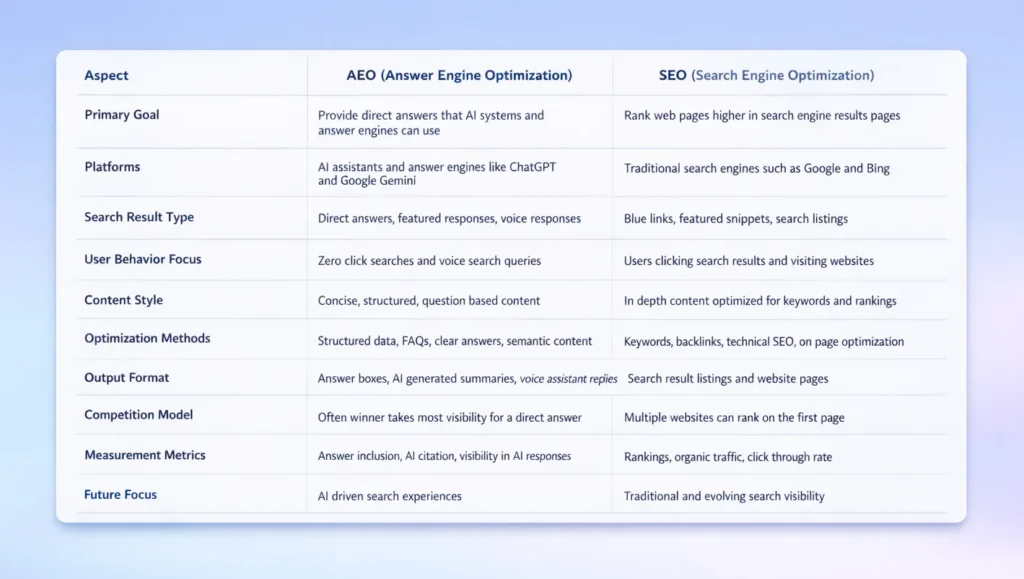
Although AEO and traditional SEO share similarities, they focus on slightly different outcomes. Search engine optimization primarily aims to improve rankings in search results pages, driving users to click on links and visit websites. It involves keyword research, backlink strategies, technical optimization, and content improvements.
AEO, on the other hand, focuses on becoming the source of direct answers. Instead of only aiming for higher rankings, the goal is to ensure your content is selected for snippets, summaries, or voice responses. This requires clear explanations, structured formatting, and strong topical authority.
However, the two approaches are not separate strategies competing with each other. In reality, they work best when combined. A strong SEO foundation ensures your website is discoverable and indexed properly, while answer-focused optimization helps your content become the preferred source for AI-driven responses.
Businesses that integrate both approaches can maximize their visibility across different types of search experiences.
Conclusion of Answer Engine Optimization
The way people search for information continues to evolve, and businesses must adapt to remain visible in modern search environments. By focusing on clarity, structured content, and accurate information, organizations can improve how their content is interpreted by AI-powered platforms.
Implementing answer engine optimization helps websites become reliable sources that provide immediate value to users. As search engines and AI assistants increasingly prioritize direct answers, creating helpful, well-organized content will be essential for building authority and maintaining visibility in the digital landscape.
Looking for Expert AEO and SEO Services?
WebDesignCochin provides the best SEO services and Answer Engine Optimization (AEO) services to help businesses improve search visibility and reach their target audience. We create strategies that make your website and content easier for search engines and AI-powered platforms to understand and discover. Contact us today to improve your online visibility.